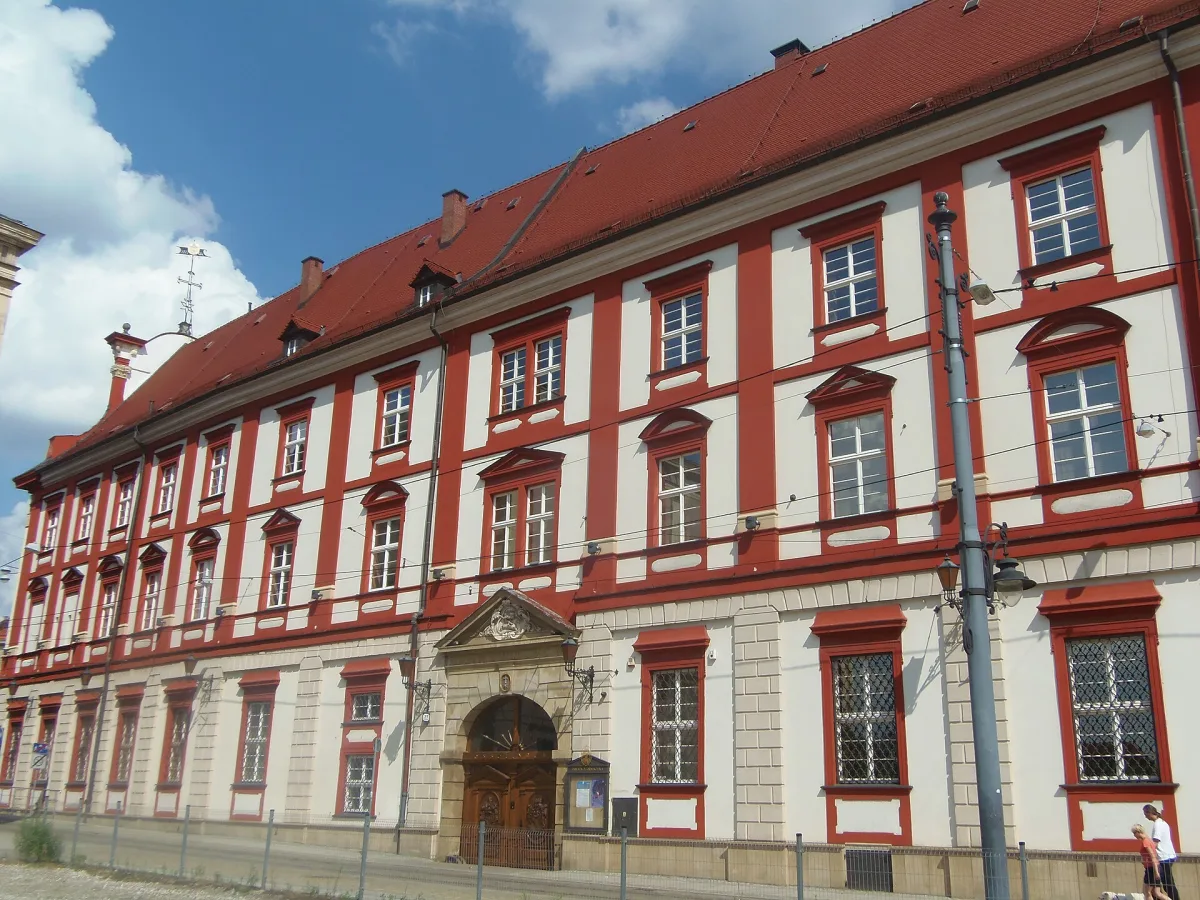
A branch of the Ossolineum on Szewska street with almost 319,000 exhibits, including drawings by Dürer and the largest collection of Rembrandt drawings in Poland.
The Museum of the Lubomirski Princes in Wrocław is a branch of the Ossoliński National Institute, located at Szewska 37 in the Old Town. It houses works of art and historical mementoes connected with the history of Poland, including the Eastern Borderlands.
The museum was established under an agreement signed on 25 December 1823 between Józef Maksymilian Ossoliński and Prince Henryk Lubomirski. The two combined their art collections, and Lubomirski took on the role of literary curator of the Ossolineum. The museum's seat was then in Lviv, and its permanent exhibition was opened in 1870 in the left wing of the Ossolineum building.
In 1921 Jan Gwalbert Pawlikowski donated more than 25,000 prints and drawings to the museum, significantly enlarging the collection. In May 1940, after the occupation of Lviv, the museum was liquidated by the Soviet Union. Restitution of the collection and its move to Wrocław took place in 1995, together with the whole Ossolineum, which after the war moved its seat to Lower Silesia.
The collection numbers almost 319,000 items. It includes more than twenty original drawings by Albrecht Dürer and the largest collection of Rembrandt drawings in Poland. The museum also holds one of the richest numismatic collections in the country, paintings by European and Polish masters, including Jan Matejko and the Kossak family, as well as historic weapons and militaria.
The museum is housed in the former Church of St Agnes and the Carmelite convent, adapted for the institution's needs. The historic form of the former monastic complex made it possible to arrange exhibition rooms inside holding both paintings and drawings, and numismatic and militaria collections.
As a branch of the Ossoliński National Institute, the museum operates in close connection with that institution, one of the most important scholarly and cultural bodies linked to the heritage of the former Eastern Borderlands. The fate of the Lubomirski Museum, from the very beginning, that is from the 1823 agreement, has been inseparably tied to the fate of the Ossolineum itself.
The museum lies in the very heart of the Old Town, surrounded by a dense network of monuments and museum institutions. Directly nearby are the Museum of Man in Wrocław and the Mausoleum of the Silesian Piasts.
A few hundred metres further on are the Aula Leopoldina and the Museum of the University of Wrocław, and towards the market square, Bishop Nankier Square.

Be the first! Add a comment.
You need to log in to add a comment.
Log in