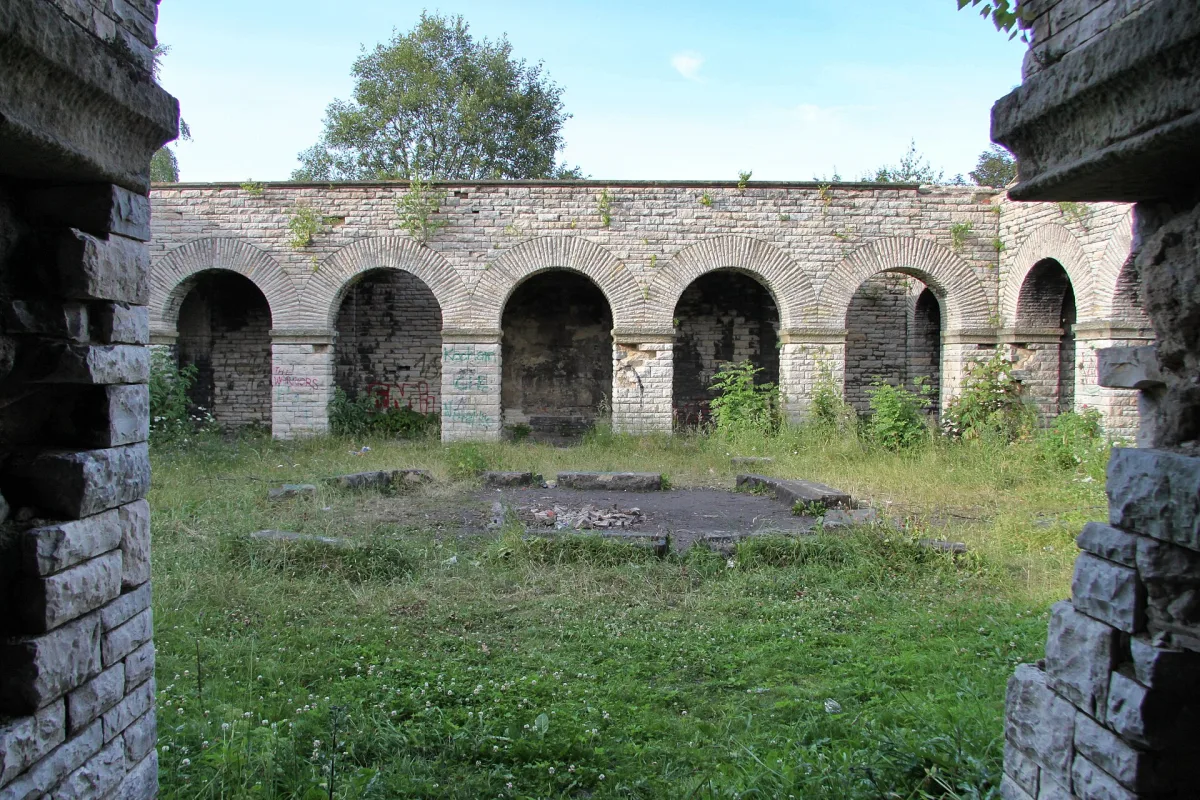
A partly ruined 1936-1938 cenotaph commemorating fallen Silesians, currently subject to rescue works.
The Mausoleum in Wałbrzych is a monumental structure built between 1936 and 1938 in honour of fallen Silesians, today largely in ruins and subject to rescue works. Despite its name, it is not a mausoleum in the literal sense, but a cenotaph, that is, a symbolic tomb without any actual burials.
The mausoleum was meant to commemorate around 170,000 Silesians who died during the First World War, as well as victims of mining accidents and 25 local activists of the National Socialist movement. Originally, the local authorities planned to honour 1,780 fallen residents of Wałbrzych, but the scope of the commemoration was expanded under Nazi rule.
Construction took place between 1936 and 1938, commissioned by a German organisation responsible for maintaining war graves. The official opening took place on 9 June 1938. The design was prepared by architect Robert Tischler, who for many years served as the chief architect of that organisation.
The mausoleum takes the form of a four-sided, fortress-like block measuring about 24 by 27 metres and around 6 metres high. It encloses a closed, square courtyard with an arcaded portico and vaulted passages. Triassic limestone from Gogolin was used to build the walls and arcades, while the cornices and portals were made of Upper Cretaceous sandstone from Łączna. The interior was decorated with mosaic ceilings in the colours of marble and gold, and floors of Karkonosze granite. The central element was a bronze column designed by Ernst Geiger, weighing about 2,100 kilograms, topped with four lions with open jaws, inspired by the Brunswick Lion.
In 1945, before the Soviet army entered, the Germans partially destroyed the complex. The bronze column went missing, although documentation confirms it still existed in 1946. Below the surface, the layout of rooms reflecting the plan of the above-ground structure has been preserved, with no known connections to other infrastructure. In 2020, a rescue campaign for the mausoleum began, as part of which clean-up works were carried out in 2021, uncovering, among other things, stone eagles and concrete foundations for flagpoles.

Be the first! Add a comment.
You need to log in to add a comment.
Log in