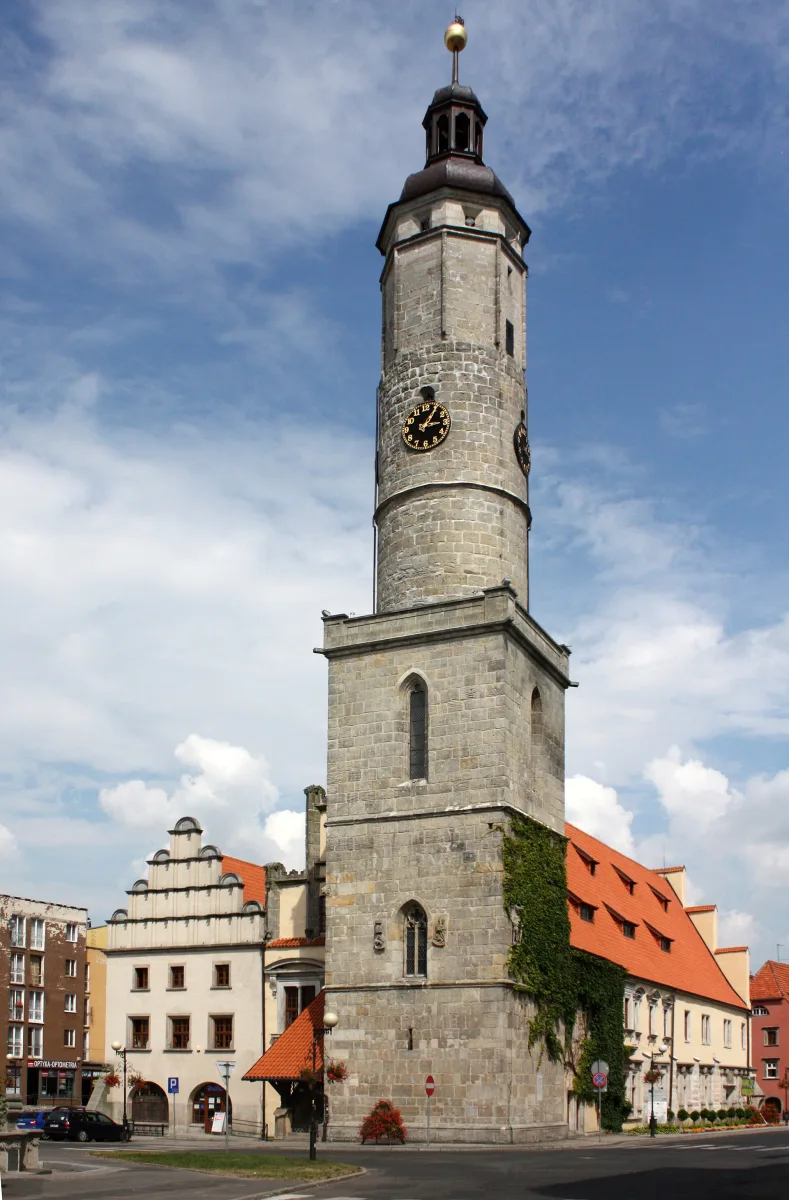
A 16th-century Gothic-Renaissance town hall on Plac Wolności in Lwówek Śląski, today housing the town authorities and a museum branch.
The Town Hall in Lwówek Śląski stands on Plac Wolności and is one of the oldest buildings of its kind in Lower Silesia. The Gothic-Renaissance structure with its distinctive tower today houses the town authorities, a library and a historical museum branch, and is listed on the heritage register as a Class I monument.
The first building on this site was erected as early as the 13th century as a merchants' house. The word "town hall" appears in documents relating to this building for the first time in 1356. The building gained its present Gothic-Renaissance form in 1522-1524, during rebuilding carried out by the architect Wendel Roskopf.
The tower with its clock faces was added in 1480-1504, and the Renaissance oriel window was built in 1546. The first clock was installed on the tower in 1588. At the turn of the 19th and 20th centuries, in 1902-1905, the architect Hans Poelzig extended the town hall's trading arcades. In 1945 the building partly burned down, it was rebuilt in 1955-1958, and further conservation renovations were carried out in 2007-2010 and 2018-2020.
The building has the shape of an elongated rectangle with a 1:3 proportion and two storeys. Above the structure rises a tower, square at its base and turning cylindrical higher up, topped with four clock faces. The south facade is decorated with a portal and double windows in surrounds with plant motifs and mascarons.
The building today houses the town authorities, the Registry Office, a library, the Historical Museum branch and a restaurant. Since 2008 a bugle call has sounded from the tower daily at 12:00. Inside, historic tombstone slabs from the 16th and 17th centuries have survived.
The historical museum branch operating in the town hall gathers collections relating to the history of the town and the region, and the building's interior rooms, including those with surviving tombstone slabs, allow visitors to trace the successive stages of its centuries-long rebuilding, from its Gothic beginnings to its Renaissance and 20th-century additions.

Be the first! Add a comment.
You need to log in to add a comment.
Log in