
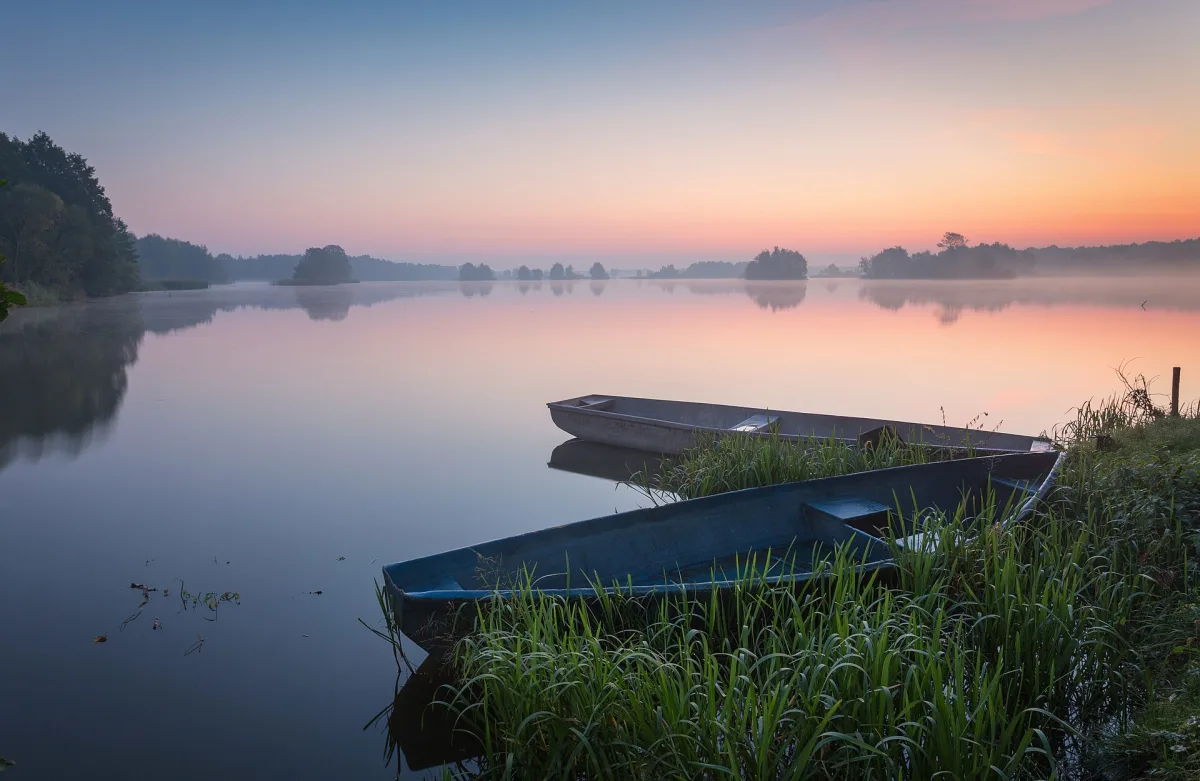
Why these ponds attract so many birds
The Stawy Milickie nature reserve is part of the Barycz Valley Landscape Park and covers more than 5,300 hectares, divided into five separate pond complexes: Stawno, Radziądz, Ruda Sułowska, Jamnik and Potasznia. It was established on 8 July 1963, and in 1995 it was placed on the list of wetlands protected under the Ramsar Convention, an international agreement covering areas of particular importance for waterfowl. The whole Barycz Valley Landscape Park has the status of a special protection area for birds within the Natura 2000 network and, according to data cited in studies on the park, is home to 276 bird species, 166 of them breeding.
The reason for this concentration of birdlife is simple: three habitats overlap here in a small area at once - fish ponds with shallow water and reed beds, wet meadows and woodland. In the ponds themselves around 250 species of algae have been recorded, and the water is home to yellow water-lily, white water-lily and reed canary grass; together these form the food base that lets fish, amphibians and invertebrates support such a large number of birds of prey, waders and waterfowl at once.
Who nests here, and who is just passing through
About 120 bird species nest in the reserve, and a further roughly 50 appear during spring and autumn migration. Among the birds found here, also described in the educational materials of the Stawy Milickie centre, are: the white-tailed eagle, the country's largest bird of prey and the bird on Poland's coat of arms, of which around seven hundred individuals live in the whole country today; the white stork and the rarer, more shy black stork; the crane, which in western Europe now occurs only in isolated pockets because of the drainage of wetlands, but is still seen here regularly; the grey heron, the most common heron species in Europe, and the great egret, a guest more rarely seen in Poland. On the water it is also easy to come across the mute swan and the whooper swan, the kingfisher hunting from ambush at the water's edge, greylag geese flying in skeins, coots, great crested grebes in their distinctive breeding plumage, and black-headed gulls and common terns circling over the surface of the water.
Species also differ in how they use the ponds. Some, such as the coot or the grebe, spend the whole spring and summer here, raising their young among the reeds. Others, such as the greylag goose, appear mainly during migration, using the ponds as a place to rest and feed on the way to their wintering grounds or back.
Seasons and what to see when
Spring, roughly from March to May, is the breeding and courtship season - this is when it is easiest to see the birds' courtship displays, including the characteristic dances of grebes on the water. In summer the ponds are busy raising young; bird activity is high but less spectacular than during migration periods. In autumn the harvest begins: fishermen drain the water from the commercial ponds, and the exposed muddy beds turn into a feeding ground for wading birds. Together with the autumn migration, this makes the season the busiest time of year for a bird watcher. In winter, when most of the ponds freeze over, activity clearly drops and the reserve grows quieter, although open patches of water can still gather the birds that have stayed behind.
How to enter the reserve - routes, stops and a guide instead of a tower
Stawy Milickie is a strict ornithological reserve, so free entry to its grounds is not possible. The source material does not confirm the existence of permanent, publicly accessible observation towers inside the reserve; the main sanctioned way in is FotoSafari, a tour run by electric vehicle or bicycle through the strict reserve in Ruda Sułowska. It is one of the few chances to actually get onto the protected grounds at all. Every tour is led by a guide, who talks about the fishing tradition of Stawy Milickie and takes participants through planned observation stops; for the duration of the route participants are given binoculars, and the guide has a spotting scope to show the birds up close. The route runs, among other places, past Staw Mewi Duży, pointed to as a good spot for observing herons, ducks and grebes. The starting point is the area around the NATURUM Educational and Tourist Centre in Ruda Sułowska, where it is worth starting the visit and booking a place in advance. Outside the boundaries of strict protection, a network of dykes and dirt roads runs through the Barycz Valley between the individual pond complexes - that is where, without a guide, it is easiest to observe waterfowl feeding close to the banks.
Rules of behaviour in the reserve
Since entering the strictly protected area is really only possible in an organised group with a guide, the basic rule is: stay on the marked route and don't stray from the group. In the breeding season, that is in spring, birds are especially sensitive to noise and the closeness of people; staying quiet and avoiding sudden movements increases the chance of encountering shy species such as the black stork or the kingfisher, and at the same time doesn't disturb them while they raise their young. On the dykes and public roads outside the reserve the same common-sense rules apply: don't leave the marked paths onto the pond grounds, don't approach nests too closely, and keep your distance once a bird starts reacting to your presence as an observer.
Basic equipment and how to start
For observing on your own, a pair of binoculars, comfortable, muted clothing that doesn't scare off birds with its colour, and patience are enough; some species, especially waders, only show themselves after a long, still wait on a dyke. If you don't have the equipment yet, FotoSafari solves that problem: participants get binoculars for the duration of the route, and the guide has a spotting scope for closer observation, so it's a good way to try out the hobby before investing in your own gear. For beginners, the natural starting point is NATURUM in Ruda Sułowska - from there it's close both to the FotoSafari site and to the public dykes leading between the pond complexes, where you can practise identifying birds on your own, at your own pace.
Be the first! Add a comment.
You need to log in to add a comment.
Log in