
Wrocław is a city built around a river and islands, with its market square, bridges and parks lying close to one another, so a weekend here can be planned from start to finish without a car. Below are suggestions on what to cover on foot, where to go by tram or bike, how to make use of a boat trip on the Oder, and how to spread it all across two days.
Old Town: everything within walking distance
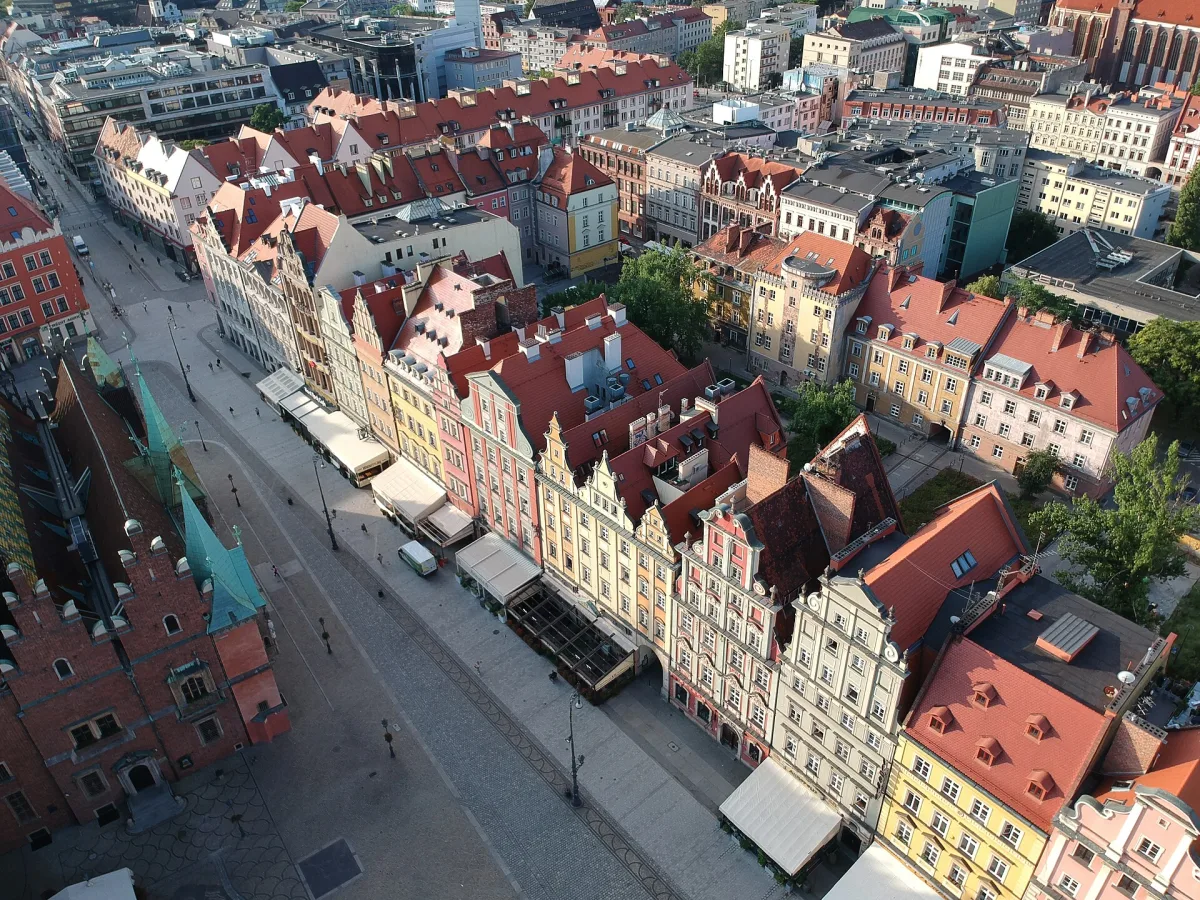
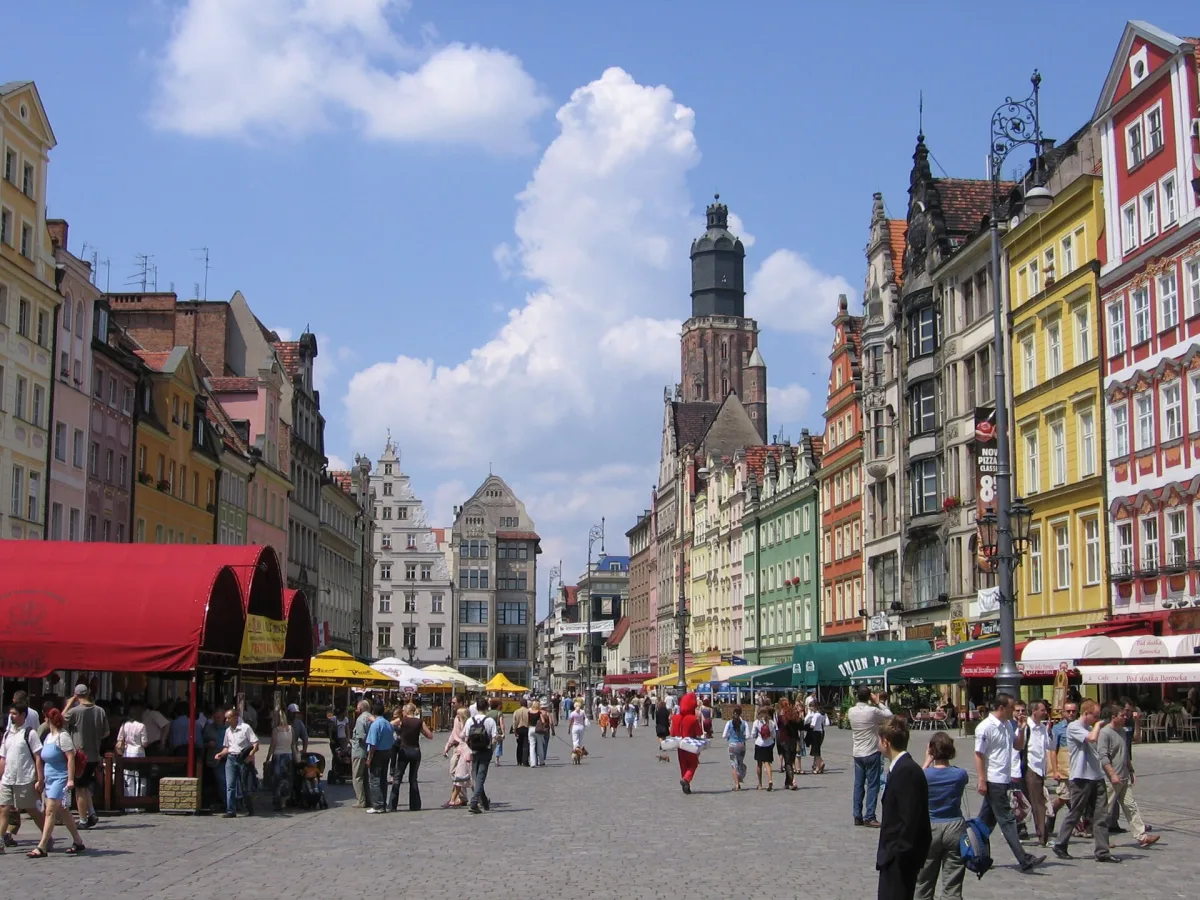
The centre of Wrocław is compact enough that it can be covered on foot in a single unhurried day. The starting point is the Market Square, one of the largest old-town market squares in Europe, laid out as early as the 13th century, with a block of buildings in the middle housing the Old and New Town Hall. Right by the Market Square, between Szewska and Łaciarska streets, stands the Gothic St Mary Magdalene's Cathedral in Wrocław, with its distinctive footbridge linking the two towers.
From the Old Town, a short walk leads across Tumski Bridge, a steel bridge from 1889 connecting Sand Island with Ostrów Tumski (Cathedral Island), today open to pedestrians only. On Ostrów Tumski it is worth planning a longer stop at Cathedral Square and the Archcathedral of St John the Baptist, one of the oldest cathedrals in Poland, built on the site of three earlier churches. The whole route from the Market Square across the bridge to Ostrów Tumski is a walk measured in minutes, not kilometres, so it fits easily into a single morning.
Greenery and islands: by tram or by bike
A few key places lie too far for a walk after a full day's sightseeing, but they are still easy to reach by tram or city bike. Szczytnicki Park, one of Wrocław's largest parks, spread over around a hundred hectares east of the Old Oder, contains the Japanese Garden, founded in 1909-1913 on the initiative of Count Fritz von Hochberg. It combines a public garden, a water garden and a tea garden, rebuilt after the flood of the century in 1997.
Closer to the centre, in the Old Town, a good stop for a rest between sightseeing is Mikołaj Kopernik Park, laid out on the inner side of the former city moat and inspired by the 19th-century Tivoli Gardens in Copenhagen. On Ostrów Tumski, right by the cathedral, lies the Botanical Garden of the University of Wrocław, the second-oldest botanical garden in Poland, founded in 1811, partly on land reclaimed from former city fortifications. All three of these places can be reached by bike in a matter of minutes from the Market Square, with no need to look for a car or a parking space.
Centennial Hall, the zoo and Afrykarium
The next natural stop on a weekend route lies in the Biskupin district, conveniently reached by tram. Centennial Hall, a reinforced-concrete exhibition and sports hall designed by Max Berg and built in 1911-1913, stands at the centre of the exhibition grounds, which also include the Four Domes Pavilion, a multimedia fountain and the entrance to the Japanese Garden: one tram stop, several attractions at once.
A few minutes' walk from Centennial Hall, along the Oder, lies the Wrocław Zoo, the oldest in Poland, operating continuously since 1865, and on its grounds the Afrykarium, the first oceanarium in Poland dedicated to African fauna, its building designed on the plan of a ship. This whole part of the city, from Centennial Hall to the zoo, works well as an afternoon linked by a single tram route back towards the centre.
A boat trip on the Oder as a way of getting around
The Oder flows right through the centre of Wrocław, and a boat trip on the river is both an attraction in itself and a way to see Tumski Bridge, the cathedral and Ostrów Tumski from a completely different angle than from the pavement. The water routes usually link the area around Ostrów Tumski with further points along the river, so the trip can be treated as part of getting between two elements of the weekend plan, not only as an extra excursion. If the weather is favourable, it is worth setting aside part of an afternoon for it, especially after a walk through Ostrów Tumski, once your legs have had enough, and the view of the city from the water offers a different perspective on what you have already seen up close.
Two days, step by step
The first day is best started at the Market Square and St Mary Magdalene's Church, then continued across Tumski Bridge to Ostrów Tumski, taking in the archcathedral and Cathedral Square, and finishing with a visit to the Botanical Garden right next door. The afternoon is well rounded off with a boat trip on the Oder, if one happens to be running, or a leisurely walk across Grunwaldzki Bridge, a historic suspension bridge from 1910 supported on two masonry pylons, towards Mikołaj Kopernik Park.
The second day is better planned around a tram ride towards Biskupin: first Centennial Hall and the exhibition grounds, then a walk through the Japanese Garden in Szczytnicki Park, and finally the Zoological Garden with Afrykarium, which on its own takes several hours. Such a plan makes it possible to see both the historic centre and the newer, green part of the city, without a single journey that could not be made by tram, bike or on foot.
Getting there from the station
Główny Station lies close enough to the Old Town that a simple, quarter-of-an-hour walk in a straight line leads to the Market Square, and for anyone with luggage a tram departing from in front of the station building towards the centre works just as well. From there, without a car and without looking for a parking space, the rest of the route described above begins: the Market Square is the natural starting point for both days of the weekend.
Be the first! Add a comment.
You need to log in to add a comment.
Log in