Nature in Błażejów means Permian porphyry, lower montane spruce forest and the Kruczy Kamień and Głazy Krasnoludków reserves.
What rock makes up the Krucze Mountains?
The base is Permian igneous rock. Pośrednia (789 m) consists entirely of porphyry, including trachyte. Widok (712 m) is built of the same rocks and belongs to the western wing of the Intra-Sudetic Basin. Końska Góra (813 m) is made of porphyry, that is trachyte, and rhyolitic tuff, while Wiązowa is also Permian porphyry. Such a base explains the shape of the hills and the kind of forest that grows on them. Wiązowa was once called Ulmen Berg in German, and Końska Góra Pferde Berg. The names are worth remembering because they help you find the summits on older maps.
What grows on the slopes?
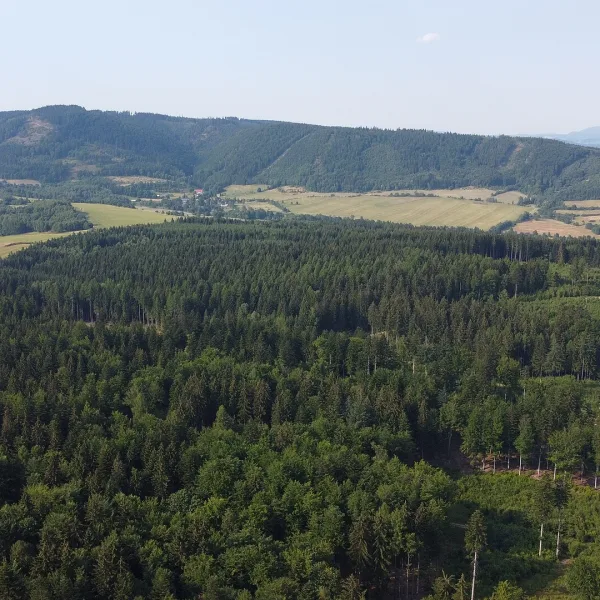
The slopes of Pośrednia are covered with lower montane spruce forest, here and there mixed with beech. It is similar on Końska Góra, which is covered in spruce forest. That is the simplest way to see what the lower montane belt looks like in this part of the Central Sudetes. Gołota (762 m) lies among a dense cluster of small hills, right next to Pośrednia, and Owcza Głowa has a flat, wide top on which no single summit stands out.
Which protected areas lie nearby?
Around these summits you will find Krucza Skała and the Kruczy Kamień nature reserve. For Owcza Głowa the sources also list the Głazy Krasnoludków reserve, a little further away. You can reach each of them with your own route plan: the marked trails are a yellow hiking one from the Krzyżówka BHP pass to the Polish-Czech border and a green cycling one starting and ending in Lubawka. In a reserve keep quiet and stay on the paths, because protection means restrictions. Owcza Głowa lies between Gołota and Zajęcznik, which makes it a natural starting point towards Krucza Skała.
See also the pages on nature across the region, things to do in Błażejów and mountains. Nearby lies Kamienna Góra.

 Mountains