Nature in Głuszyca means Precambrian gneiss and lower-montane forests on Owl Mountains summits, some of them inside a landscape park.
What rock are the mountains near Głuszyca made of?
The summits lie in the Central Sudetes and are built of Precambrian gneiss, which geologists call Owl Mountains gneiss. This applies to Włodarz (811 m above sea level), Osówka (716 m), Moszna (771 m) and Jaworek (781 m). They all lie in a separate range that runs from the Sokola Pass through Sokół to Jedlińska Kopa and Strażowa Góra. The old German names also say something about the terrain: Osówka was Säuferhöhen in German, and Moszna was Mulenberg.
What forest grows on the slopes?
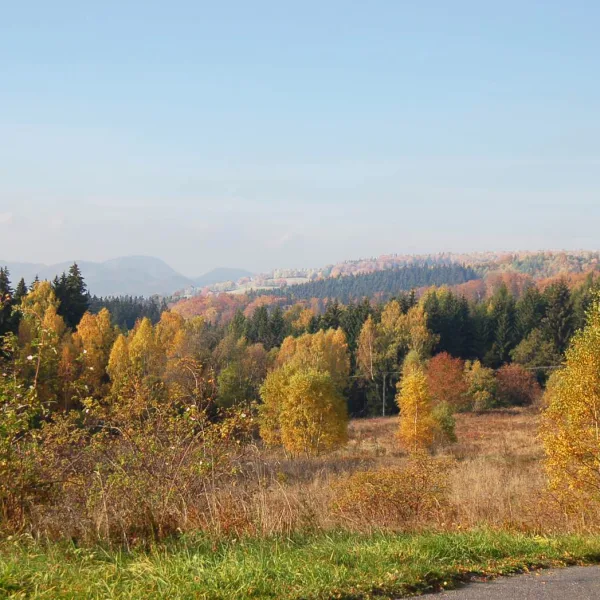
Spruce forest of the lower montane zone dominates. On Moszna it has a touch of beech, and on Jaworek and Jedlińska Kopa it is spruce and beech forest covering the summit and slopes. Osówka is covered with spruce mixed with broadleaf trees. The hills are domed, with flat, clearly marked summits and fairly steep slopes, and Osówka rises only about 16 metres above the surrounding terrain. Forest therefore covers both ridges and slopes, and its makeup differs from peak to peak.
Where does nature end and human trace begin?
Jaworek and Jedlińska Kopa lie within the Owl Mountains Landscape Park, the same park in which Włodarz rises. The area was kept secret in World War II because of the Riese complex, and on the slopes of Jedlińska Kopa remains of a narrow-gauge railway survive to this day. Nature and history interweave here at every step. Check the route and trail marking before you set out, since the descriptions do not give them.
Want to see the whole group of peaks? Look at mountains in Głuszyca. Ideas for an outing without spending are gathered in free attractions in Głuszyca, and the town overview is attractions in Głuszyca. A wider choice in the region sits under nature.

 Mountains