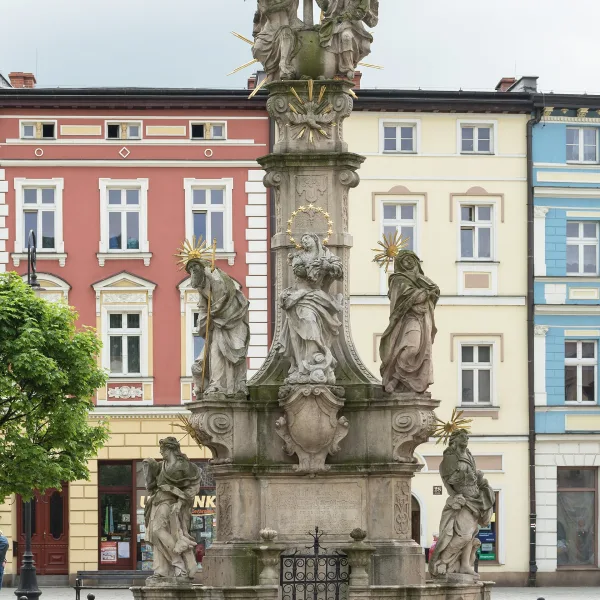
a seven-metre baroque votive sandstone monument, erected after the town fire of 1739
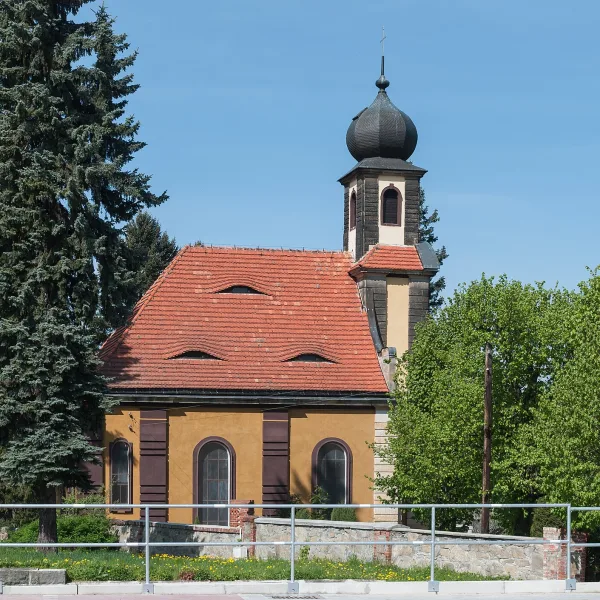
an active 19th-century necropolis, with a cemetery chapel from 1908
an active necropolis founded in 1616, with the baroque Church of St Roch as its funeral chapel
a seven-metre baroque votive sandstone monument, erected after the town fire of 1739
an active 19th-century necropolis, with a cemetery chapel from 1908
an active necropolis founded in 1616, with the baroque Church of St Roch as its funeral chapel
Cemeteries and monuments in Lądek-Zdrój mean a Baroque Trinity column on the square and two active cemeteries on Śnieżna street, with St Roch's church.
The Holy Trinity Monument on the west side of the market square. It is a Baroque votive figure carved in sandstone in 1739-1741 by the sculptor Michael Klahr the Elder. It is about 7 metres high, an obelisk with a wide plinth and a slender pillar. On the balustrade stand figures of St Luke the Evangelist, St John the Evangelist and St Anthony of Padua. The monument stands on the square, so it is easy to combine with a walk around the spa centre.
Both are active, so keep quiet. The parish cemetery at Śnieżna 12 is the largest in town. It was founded in the second half of the 19th century and enlarged in the late 1970s by taking in the neighbouring Protestant cemetery. Among its monuments are a chapel from 1908 and a passion cross from 1877.
The municipal cemetery is older: it was founded in 1616 under an agreement between the town authorities and the parish of the Nativity of the Blessed Virgin Mary, replacing a cemetery by the parish church. On its grounds stands the Baroque church of St Roch from 1678, which serves as a funeral chapel.
Want wider context? See mountains in Lądek-Zdrój, free places in Lądek-Zdrój or the page of Lądek-Zdrój attractions. Cemeteries of the whole region are collected under cemeteries and monuments of the region.