Nature in Nowa Wieś means gneiss summits, lower montane forests and streams of the Śnieżnik Massif, largely inside a landscape park. What the mountains hold.
What rock are the mountains near Nowa Wieś made of?
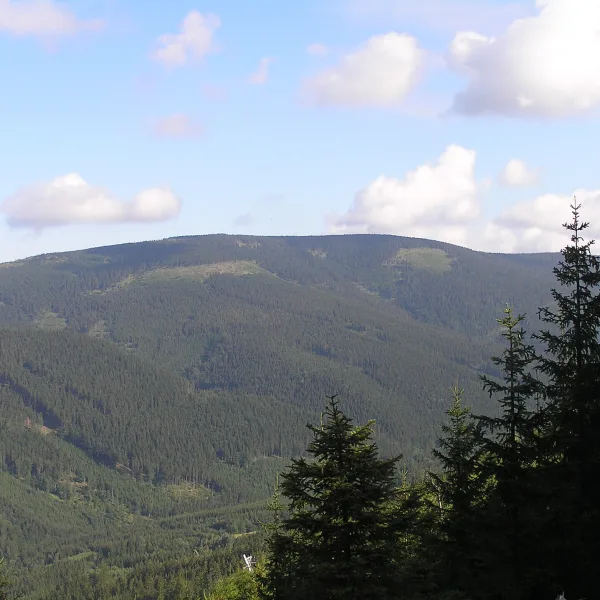
Gneiss from the Lądek-Śnieżnik metamorphic complex dominates. Mały Śnieżnik has a summit and western slopes of gneiss, while the eastern ones are mica schist with bands of quartzite, graphite schist and amphibolite, with rock rubble in places. Szeroka Kopa and Wysoczka are built of Śnieżnik gneiss. The same goes for Sośnik, whose bedrock is gneiss typical of this part of the Sudetes. Rock shows more clearly where the forest thins, and on Mały Śnieżnik rock rubble lies in places. Goworek, the twin of Mały Śnieżnik, is 1,320 m, and Puchacz 1,175 m. Both belong to the same gneiss block that makes up the Śnieżnik Massif in the Eastern Sudetes.
What forest and streams will you meet?
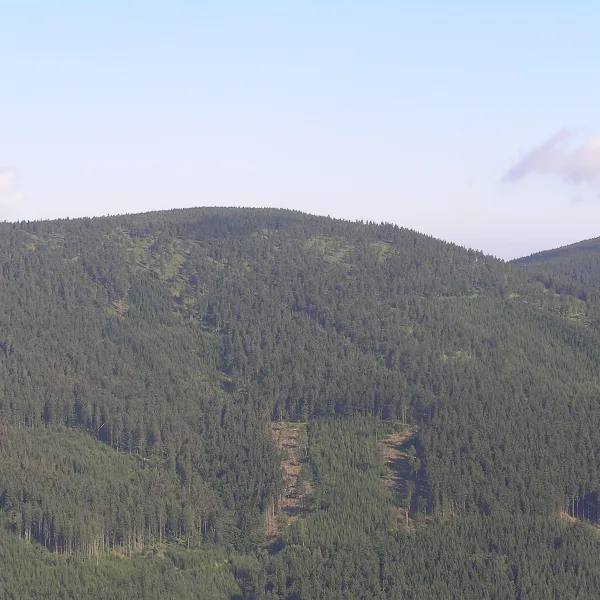
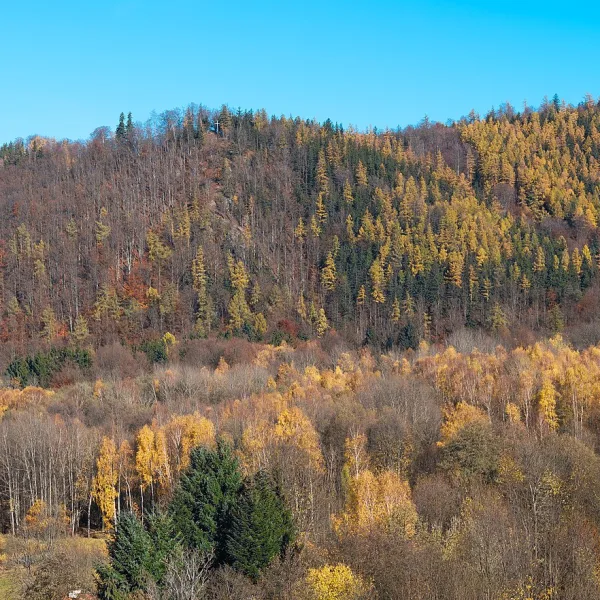
Spruce dominates. Wysoczka is covered by lower montane spruce forest, and the Nowinka stream rises on its western slope. Szeroka Kopa carries lower montane spruce forest with some beech, flanked by the valleys of the Domaszkowski stream and the Wilczka. Gawlik has spruce forest typical for its height, and Sośnik beech and spruce forest on a steep ridge dropping towards the upper valley of the Nysa Kłodzka. Owcza Góra lies close to the Wilczka Waterfall, one of the most visited spots in the region, and in German times it was called Schafberg. Sources describe Sośnik differently: once as 580-690 m for the whole hill, once as 707 m for the summit point.
Which areas are protected?
Mały Śnieżnik lies inside the nature reserve of the same name. Near Puchacz and Goworek is the Śnieżnik Kłodzki reserve. Wysoczka, Gawlik and Owcza Góra lie in the Śnieżnik Landscape Park, and Sośnik at its edge. Gawlik is close to Śnieżnik and Mały Śnieżnik, so in an area under protection, with spruce forest typical for its height. Check detailed nature protection rules, bans and hours in the reserves at a tourist information point before you go, because the listings do not give them.
Where is it quieter, and where is there a trail?
Jasień, Puchacz and Goworek are hills of the Śnieżnik Massif whose listings tell you to check the route before setting out. On Wysoczka the blue E3 trail meets a yellow connecting trail. A yellow cycling route from the Wilczka Waterfall reserve to Nowa Wieś runs near Szeroka Kopa.
If height matters more to you, see mountains, and if the landscape itself, beautiful views. The other lists are free places and solo. Nature across the region is described on nature in Lower Silesia.

 Mountains