Nature in Kowary means wooded summits, granite with tourmaline, gneiss and the remains of an old park. See how the five mountains differ.
What rocks make up the mountains near Kowary?
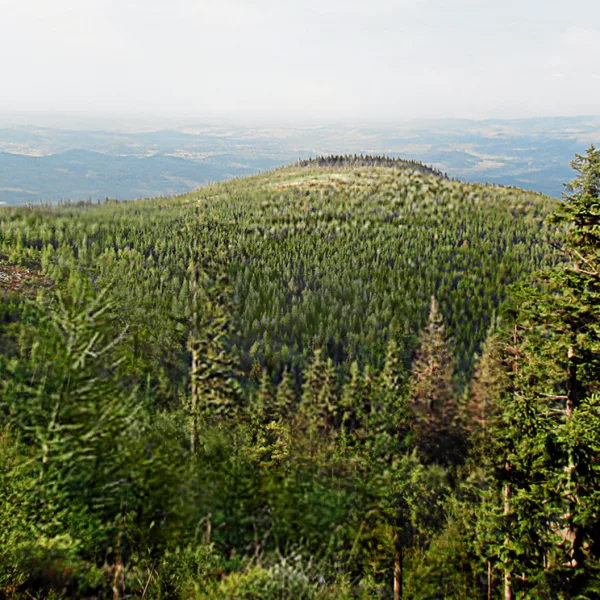
They differ more than you can see from below. Brzeźnik in the Rudawy Janowickie is built of Variscan porphyritic granite with tourmaline and hornblende. Sulica in the Lasocki Ridge is gneiss and mica schist with inserts of amphibolite and crystalline limestone. Łysa Góra in the Kowary Ridge consists of metamorphic rock, and next to it lies Wołowa Góra, the main high point of a side ridge leaving the Czoło summit. The difference shows even in shape: Brzeźnik is domed and steep, Góra Parkowa cone-shaped with equally steep slopes, and Łysa Góra has no distinct peak visible from afar.
What forest grows on the summits near Kowary?
On Sulica the top and slopes are covered with upper-montane spruce forest, and two roads with hairpin bends climb its slopes. Add the yellow and green trails and a stone monument to a teacher. Heights differ a lot: Góra Parkowa is 550 m, Wołowa Góra 1041 m, so it is worth comparing two mountains in one day.
Where near Kowary can you see traces of an old park?
On Góra Parkowa, a cone-shaped hill above town in the Rudawy Janowickie in the Western Sudetes. On its southern slope a landscape park was laid out in the early 19th century in the Romantic spirit. Only remains survive, so you walk through a forest that was once designed.
Finally, compare what you see with the description: granite on Brzeźnik, gneiss on Sulica, traces of a park on Góra Parkowa. A list like this helps you read the landscape without specialist knowledge. Just watch the numbers: some measurements give Sulica as 946 m, not 942 m.
To round it off, check beautiful views in Kowary, mountains in Kowary and nature across the whole region. The main town page is Kowary attractions.

 Mountains