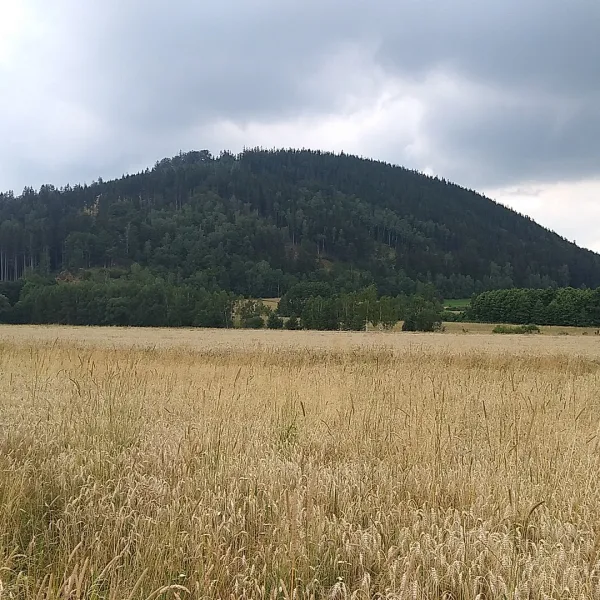
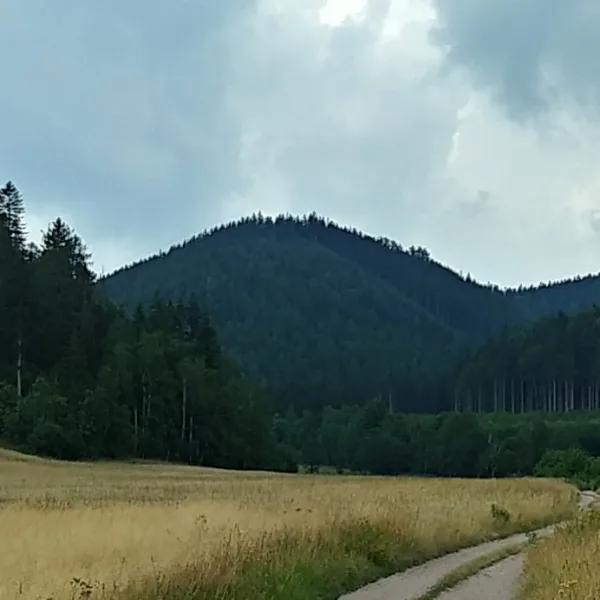
Mountains in Lubawka means five Raven Mountains summits from 681 to 747 m. See which has a view, which has red rocks and which is completely wild.
Which Raven Mountains summit is the highest, and which the lowest?
The highest of the five is Bógdał (747 m), about 3 km south of Lubawka's centre. Next comes Sępia Góra (about 740 m), then Skowrończa (707 m), Pustelnia (683 m) and the lowest, Krucza Skała (681 m). The differences are small, so the character of a hill matters more than the numbers.
How do these summits differ?
Krucza Skała has a viewpoint over the Lubawka Gate and the Karkonosze, and two hiking trails nearby. Sępia Góra and Bógdał have domed shapes and red porphyry crags on their slopes: the first on the south-eastern one, the second on the eastern. Bógdał lies in a side ridge between the Valley of Love and the Raven Valley. Despite its monastic name, Pustelnia (the Hermitage) is not a religious site but a hill with an old porphyry quarry on its north-western slope. Skowrończa is wooded and not prominent, and sources mention no trails or viewpoints at its summit.
What are the Raven Mountains made of?
Mostly Permian volcanic rocks: porphyry, also called trachyte, and on Krucza Skała trachybasalt, trachyandesite, rhyolite and rhyolite breccia. At the foot of Pustelnia there are red sandstones and conglomerates. Lower montane spruce forest with some broadleaf trees covers the slopes. If you like reading a landscape, watch the colour of the rocks and the shapes of the hills.
For one day it makes sense to pair Sępia Góra with Bógdał. Sępia lies on the western side of the Valley of Love, and Bógdał in a side ridge between that valley and the Raven Valley, so the two hills are close together and share a similar domed shape.
All five summits carry the free tag. More plans are on the Lubawka attractions page, in the list of mountains of the region and among scenic views and nature.

 Mountains