Jelenia Góra attractions: Chojnik Castle, the spa district of Cieplice, museums for rainy days and play centres at the foot of the Karkonosze.
This list covers Jelenia Góra itself together with the districts that once had their own history: Cieplice, Sobieszów and Jagniątków. In one place you get a medieval old town, historic parks, a castle ruin on a hilltop and several good ideas for days without views.
Where to start sightseeing in Jelenia Góra?
Start with the old town and keep Chojnik Castle for a separate part of the day. The easiest walk begins at the fountain on the Town Hall Square, close to the castle gate tower and the Wojanów Gate. When it rains, head for Cieplice.
The Neptune Fountain stands where the town well used to be and recalls the trade links of local merchants. It is open at any hour, free of charge. A few steps further stands the castle gate tower, the only surviving part of the medieval town gate. It took its present shape in 1584, and the gallery under the octagonal top works as a viewing platform. On the roof you will see a weathervane with a stag, the symbol of the town.
At the eastern end of the old town waits the Wojanów Gate. It is a Baroque gate from 1763, decorated with rococo cartouches with the arms of Jelenia Góra, Prussia and Silesia. In the evening check the programme of the Cyprian Kamil Norwid Theatre: its Art Nouveau building from 1904 houses one of the oldest working drama theatres in Lower Silesia. The current calendar is on the page of events in Jelenia Góra.
What to see in Cieplice Śląskie-Zdrój?
In Cieplice you will find spa parks, the Schaffgotsch palace, two churches and a natural history museum. It is a district of Jelenia Góra, an independent town until 1976, known for its warm springs. The main sights stand close together in the centre of the spa district, so you can walk between them.
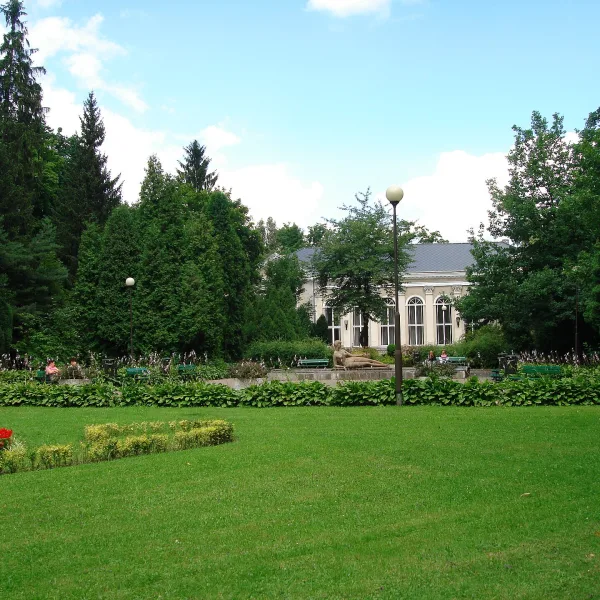
Two parks form a single promenade. The Spa Park has a spa pavilion from the late 18th century and a spa theatre from 1836, and the greenery covers more than sixteen hectares. Beyond the Wrzosówka river begins the Norwegian Park, laid out in 1906. Its landmark is the wooden Norwegian Pavilion with dragon heads on the roof ridge, modelled on a restaurant near Oslo. Today it houses a restaurant.
The Schaffgotsch Palace is seen from outside, because it houses a teaching centre of Wrocław University of Science and Technology and is closed to regular visitors. The Natural History Museum, in a former Cistercian provostry, shows collections gathered in the region since the 16th century, partly from the Schaffgotsch family.
After the walk you can enter the Cieplice Thermal Baths. It is a year-round water park with thermal pools at 27 to 36 degrees Celsius, slides and a spa zone with saunas.
Where to hike from Jelenia Góra?
The easiest summits are Chojnik, Żar and Kopista, which lie within the town limits above Sobieszów and Jagniątków. Higher goals, such as the Czeskie Kamienie rocks, take a full day. Check the exact trail routes on the Karkonosze National Park map.
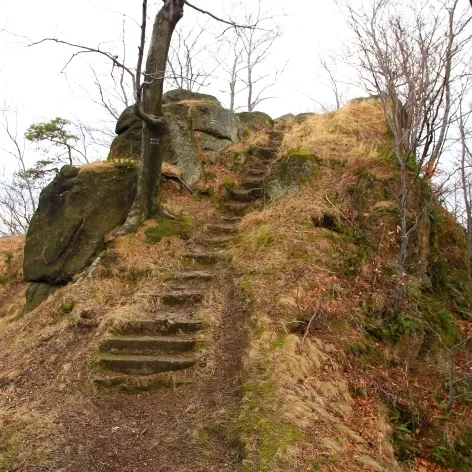
Chojnik stands 627 metres above sea level and carries a castle ruin. The castle is inside the strict protection zone of the national park, and on the south-eastern side the mountain drops 150 metres into the Hell Valley. The Gothic stronghold was built in the 1350s, belonged to the Schaffgotsch family from 1418, and burned after a lightning strike in 1675. For the history read the card of the castle. Down in the valley the Sobieszów Palace, a Baroque residence from 1705-1712, now serves as an education centre of the national park.
Żar rises 685 metres and joins the Chojnik massif through the Żar Pass. Nearby Kopista reaches 681 metres. For an easier walk choose the Krzywousty Hill. Its viewing tower, nicknamed the Mushroom, is 22 metres tall, was built in 1911 and offers a view of the Karkonosze and the town. Entry to the terrace is free. Stronger hikers can reach the Czeskie Kamienie, a summit of the Silesian Ridge at 1416 metres, with granite blocks on the ridge. More summits are listed under mountains.
What to do in Jelenia Góra with children and in the rain?
With children choose a trampoline park, a play centre or the indoor go-kart track, and for rain a museum. Jelenia Góra has several places under a roof, so the plan does not depend on the weather. Check age limits and opening hours on the venues' own pages.
Jump Heaven offers a trampoline zone with dodgeball and volleyball, a separate area with animations for the youngest and fitness classes. Another park, Wild Jump, has a climbing wall and an obstacle course. Smaller children play more calmly in the kids CLUB centre, where the multi-level frame is separated from the toddler area. From age 4 you can drive drifting Crazy Carts in the Nowy Rynek shopping centre.
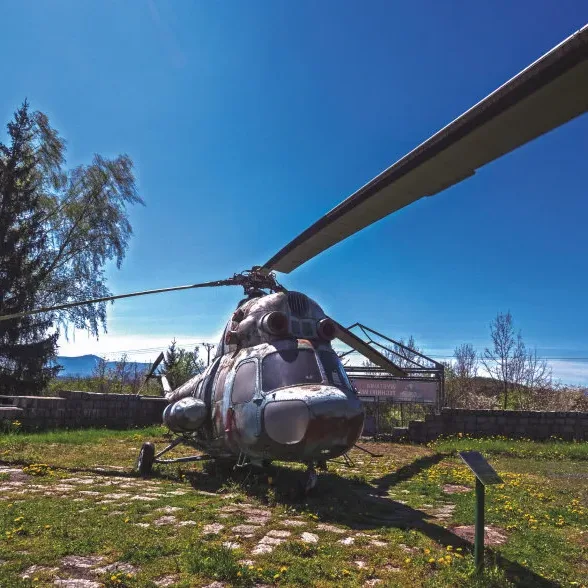
Older visitors enjoy the King Of The Lock escape room, which has three scenarios and games in Polish. The Polish Army Armament Open-Air Museum shows, among other things, a T-34 tank and an Mi-2 helicopter. For the story of the region enter the Karkonosze Museum, which has collected souvenirs of the Karkonosze and the Izera Mountains since 1889. In Jagniątków waits the Gerhart Hauptmann House, a Nobel laureate's villa from 1901. More play ideas are in the category for children.
How to combine Jelenia Góra with Karpacz and Szklarska Poręba?
Jelenia Góra is a natural base for trips to Karpacz and Szklarska Poręba. In the morning you can do a mountain section, and in the afternoon return to town or to Cieplice. Both neighbouring resorts have their own lists of attractions, so the following days are easy to plan.
For a longer stay arrange the days like this: the old town and Cieplice first, Chojnik with Sobieszów second, the distant Karkonosze third. Then check the lists of Karpacz attractions and Szklarska Poręba attractions.
Frequently asked questions
What to see in Jelenia Góra in one day?
Walk the old town from the Neptune Fountain through the castle gate tower to the Wojanów Gate, then go to Cieplice in the afternoon. There you will see the Spa Park, the Norwegian Park and the Norwegian Pavilion. If you have energy left, add the climb to Chojnik.
Where to go in Jelenia Góra when it rains?
To the Natural History Museum in Cieplice, the Karkonosze Museum or the Polish Army Armament Open-Air Museum. Families also have trampoline parks, a play centre and an indoor go-kart track. The Cieplice Thermal Baths work all year.
Can I reach Chojnik Castle without much effort?
Chojnik stands on a mountain 627 metres high, so the climb needs fitness and good shoes. Five marked trails lead to the top, so check their routes before you set off.
Is anything free in Jelenia Góra?
Yes. Walks in the old town, the Neptune Fountain and the terrace of the Mushroom tower on Krzywousty Hill are free. You can also enter the Spa Park and the Norwegian Park.

 Parks and nature