Lakes and bathing areas in Lower Silesia: reservoirs, ponds and flooded mine pits, from near Wrocław to the Karkonosze. Find where to get to the water.
This list brings together very different bodies of water: large dam reservoirs, natural glacial lakes, fish ponds, and flooded quarries and mines. Not all of them suit swimming, and some matter more to birds than to sunbathers, so read each description. If you are looking for pools and slides, go to the water parks and pools category.
Where to find water near Wrocław?
The closest is Lake Mietkowskie, about 25 kilometres south-west of the city. For a swim, drive to Wały on the Oder, and for birds and quiet walks go to the Barycz Valley and the Milicz Ponds.
Lake Mietkowskie is an artificial reservoir on the Bystrzyca river. At 9.29 km² it is the largest of its kind in Lower Silesia. It lies in the Bystrzyca Valley Landscape Park and is known for birds and windsurfing. Construction began in 1974 and filling with water ended in 1986. The reservoir mainly protects the Bystrzyca valley and Wrocław from floods.
On the Oder, about 3 kilometres from Brzeg Dolny and about 30 kilometres from Wrocław, the Wały bathing area belongs to a recreation centre. The pool reservoir is separated from the river channel, which is meant to give calmer and safer conditions for swimming. It is one of the few designated bathing areas in this part of the region.
The Milicz Ponds are not a single lake but a mosaic of dozens of ponds, dykes and canals around Milicz. Cistercian monks started creating them in the 13th century, and Milicz carp is still bred here by extensive methods. The area counts as one of the most important places in Poland for watching water and marsh birds.
Which lakes suit the Karkonosze and the Jelenia Góra Basin?
At the foot of the Karkonosze choose the Sosnówka or Bukówka reservoir for a walk around the water. For a longer trip add Lake Pilchowickie on the Bóbr river, Lake Wrzeszczyńskie and Lake Modre, and in the high mountains the Śnieżne Tarns.
The Sosnówka reservoir lies in the Jelenia Góra Basin, in the Podgórzyn commune, and from its shores and nearby hills you can see the Śnieżka massif. Construction lasted from 1986 to 2001, and the water surface measures 145 to 170 hectares. A walking path runs around it. The Bukówka reservoir in the Lubawka commune is one of the highest-lying dam reservoirs in Poland: the crest of the dam is above 537 metres. It covers about 199 hectares and also has a path by the water.
Lake Pilchowickie in the Wleń commune covers about 240 hectares, is about 7 kilometres long and up to 40-47 metres deep. You will know it by the historic dam, 62 metres high, and by the steel railway viaduct over the water. The dam was built in 1902-1912 after a catastrophic flood in 1897. Further down the Bóbr lies the younger, smaller Lake Wrzeszczyńskie with a hydroelectric plant, and near the village of Siedlęcin Lake Modre, named after the intense blue of its water.
Then there are the Podgórzyn Ponds: 22 fish ponds over about 106 hectares, founded in the 15th century by Cistercians from Cieplice. They are a quiet alternative to crowded trails and a good place for birds, right by Jelenia Góra. More sights of the town are on the Jelenia Góra page.
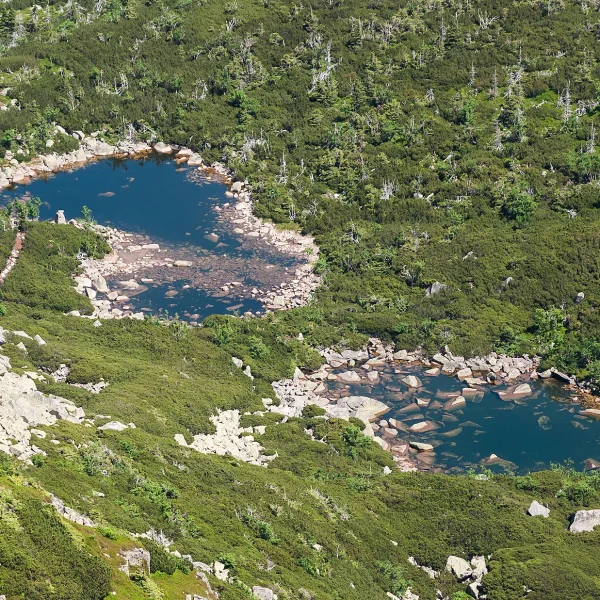
High in the mountains lie eight Śnieżne Tarns, glacial ponds on the floor of the Śnieżne Kotły cirque, at about 1250-1350 metres inside the Karkonosze National Park. It is one of the few places in the Polish mountains where you can see such ponds up close, ringed by the rock walls of the cirque. A mountain hike is a different trip from a walk by a reservoir, so look for more routes in the mountains category.
How to combine a lake with a castle?
The easiest places are on the Kwisa and the Bystrzyca: Czocha Castle stands on Lake Leśniańskie, the ruins of Grodno Castle overlook Lake Bystrzyckie, and in Kliczków a castle stands close to a reservoir.
Lake Leśniańskie covers about 140 hectares between Gryfów Śląski and Leśna, and its best-known feature is the silhouette of Czocha Castle on the shore. It is also called Lake Czocha. The reservoir was built after repeated floods on the Kwisa, including the catastrophic flood of July 1897. Downstream lies Lake Złotnickie, with about 120 hectares and a depth of up to 22 metres. The area is known for beaches and campsites, so it suits a stay of a few days.
Lake Bystrzyckie, also called Lake Lubachowskie, lies in a narrow valley of the Bystrzyca in the Owl Mountains, in the Walim commune, below a hill with the ruins of Grodno Castle. Its 44-metre dam was built in 1911-1914 for flood protection. Wooded slopes and rock cliffs give it a mountain character. In Kliczków, a lookout tower above a reservoir on the Kwisa stands a few minutes' walk from the castle, with a view of rock formations.
Where are the bathing areas, and where should you not plan to swim?
Guarded or designated bathing areas are described at Lake Kunickie near Legnica, the Radków reservoir, the reservoir in Stara Morawa, the Stradomia reservoir near Syców and the Wały bathing area. The Topola reservoir and the Dobromierz reservoir have limited or no facilities for swimming.
Lake Kunickie covers about 95 hectares and is the largest lake of the Legnica Lake District. A guarded bathing area with a mostly grassy beach and patches of sand operates by the water. It lies a few kilometres from Legnica, so it combines well with sightseeing in town, whose sights are on the Legnica page.
The Radków reservoir lies about 2 kilometres from Radków, at the northern foot of the Table Mountains. Today it is part of a recreation centre with two bathing areas designated each year, and you can see a panorama of the Polish and Czech Table Mountains from it. The reservoir in Stara Morawa, in the Śnieżnik Massif, lies at about 525 metres and opened for recreation in 2007. The Stradomia reservoir near Syców is one of the few waters in the area with a designated, guarded bathing area.
On the other hand, the Topola reservoir on the Nysa Kłodzka is mainly a technical and natural site: there is no designated bathing area, but anglers, kayakers and bird watchers come. The Dobromierz reservoir supplies drinking water, so recreation by the water is strongly limited.
Where to find lakes of unusual colours?
Look in old pits. The four Colourful Lakes in the Rudawy Janowickie, Daisy Pond near Świdnica, Lake Kryształ near Żarów and Lake Modre on the Bóbr owe their colour to water that fills mines, quarries or a river valley.
The Colourful Lakes near Wieściszowice are four small reservoirs below Wielka Kopa (871 metres): Yellow, Purple, Blue and Green, the last also called the Black Pond. They formed in flooded pits of old German pyrite mines. The smallest and most photographed is the Purple Pond, at about 560 metres, ringed by the rock walls of the pit, inside the Rudawy Landscape Park.
Daisy Pond, also called the Green Lake, formed in 1870 in a flooded quarry of reef limestone. The emerald water and rock walls lie in the Książ Landscape Park, within a nature reserve created in 1998. Lake Kryształ (Andrzej Reservoir) between Żarów and Mrowiny fills a pit of an old kaolin mine, and its name comes from exceptionally clear water, with visibility of a few metres.
Where to watch birds?
Watch birds at the Milicz Ponds, Lake Koskowickie, the Topola reservoir and the Podgórzyn Ponds. In these places reed beds, shallows and wetlands matter more than a beach.
Lake Koskowickie lies about 6 kilometres east of the centre of Legnica. It is one of the oldest glacial lakes in Poland and the second largest in the Legnica Lake District. A wide belt of reed beds surrounds it, which makes it an important refuge for water birds in Lower Silesia. The Topola reservoir, together with neighbouring Kozielno, forms the Paczków Reservoir. Lake Mietkowskie also has plenty of birds.
A wider choice of natural places is in the parks and nature category.
Where to walk or fish in town and below the mountains?
For a short walk pick the Witoszówka reservoir in Świdnica or Lake Bielawskie at the foot of the Owl Mountains. For anglers, the Słup reservoir near Jawor is described.
The Witoszówka reservoir is a small body of water of nearly 8 hectares near the centre of Świdnica, by the Słowiańskie housing estate. Locals walk, jog and fish here. Lake Bielawskie, called the Sudeten Beach, is a 1973 reservoir on the Brzęczek stream, with forests climbing the mountain slopes. The Słup reservoir on the Nysa Szalona matters for flood control and angling, and the Mściwojów reservoir near Jawor has a beach and a path around the water, and cleans the Wierzbiak river in wetlands planted with special vegetation.
Frequently asked questions
Which lake is closest to Wrocław?
Lake Mietkowskie is closest, about 25 kilometres south-west of the city. It is the largest reservoir of its kind in Lower Silesia, known for birds and windsurfing. The Wały bathing area lies about 30 kilometres from Wrocław, on the Oder.
Where is there a guarded bathing area?
Descriptions mention guarded bathing at Lake Kunickie near Legnica and at the Stradomia reservoir near Syców. The Radków reservoir has two bathing areas designated each year. Check current season information before you go.
Which lakes are best for photos?
For colour choose the Purple Pond and the other Colourful Lakes, Daisy Pond and Lake Modre. For mountain views, choose the Sosnówka reservoir with its view of Śnieżka, or Lake Leśniańskie with Czocha Castle.
Can you swim in every reservoir?
No. The Dobromierz reservoir supplies drinking water, so recreation is strongly limited, and the Topola reservoir has no designated bathing area. Choose places whose description mentions a bathing area.

 Lakes and bathing areas